Instant Connect

Scan to connect via WhatsApp or WeChat
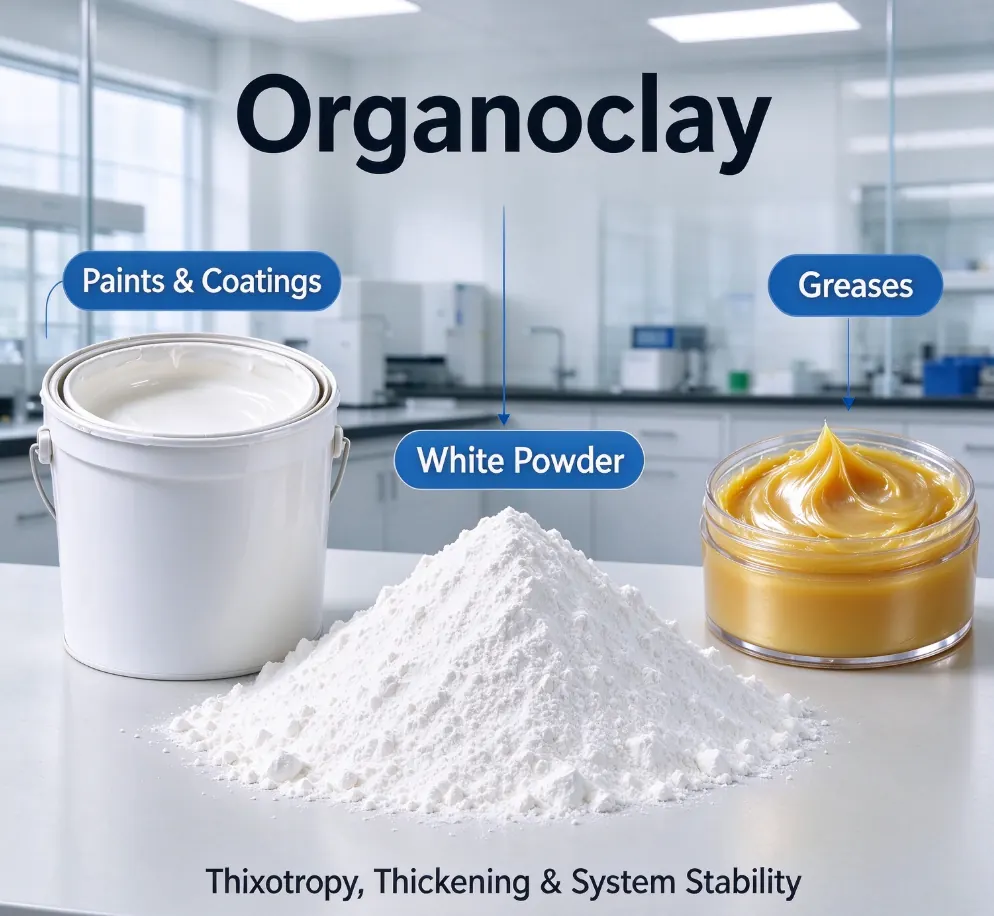
CP-40 is a conventional organoclay rheological additive for low- to intermediate-polarity organic liquids. It helps build thixotropy, suspend pigments and fillers, and improve sag resistance in coatings, lubricating grease, adhesives and sealants.
For formulation review, send our technical team your solvent or base oil, resin or binder, pigment and filler loading, and target flow or sag behavior. Request the latest CP-40 TDS, SDS, COA or a sample.
| Buyer question | CP-40 information |
|---|---|
| Product type | Organoclay rheological additive; organic derivative of montmorillonite clay |
| System | Solvent-based organic liquids |
| Polarity range | Low to intermediate |
| Activation | Conventional grade; polar activator recommended for best efficiency |
| Typical dosage | 0.2–2.0% by weight of the formulation |
| Listed applications | Coatings, grease, inks, adhesives, sealants and diesel-based drilling fluids |
| Property | Typical value | Test condition |
|---|---|---|
| Composition | Organic derivative of montmorillonite clay | — |
| Appearance | Fine white powder | Visual |
| Moisture content | ≤3.5% | 105°C, 2 h |
| Loss on ignition | <32.2% | 1000°C |
| Bulk density | 0.53 g/cm³ | — |
| Fineness | ≥98% passing 200 mesh | 200 mesh |
Values are typical product information for screening. Obtain the current grade-specific TDS and lot COA for the specification applicable to the shipment.
When dispersed and activated in a compatible organic liquid, CP-40 can develop a thixotropic structure. This structure helps increase low-shear viscosity and suspend solid particles at rest, while allowing the material to flow under application shear. Its recovery after shear supports anti-settling and sag resistance without being intended to eliminate flow and leveling.
| Application | Potential formulation role | What to validate |
|---|---|---|
| Solvent-borne paints and coatings | Thixotropy, pigment suspension and sag resistance | Settling, film build, flow and leveling; haze and color for transparent coatings |
| Lubricating grease | Rheology and consistency contribution | Base-oil compatibility, process, target consistency and stability |
| Adhesives and sealants | Thixotropy, filler suspension and sag resistance | Resin compatibility, extrusion, vertical sag and cured performance |
| Printing inks | Body and particle suspension | Vehicle compatibility, print transfer and appearance |
| Diesel-based drilling fluids | Rheology and suspension contribution | Base-fluid compatibility and the relevant mud test method |
CP-40 may also be evaluated as an alternative to fumed silica in selected solvent-borne formulations. This is a formulation-specific comparison, not a universal one-for-one replacement. Compare dispersion, rheology, appearance and end-use performance in laboratory trials.
The typical CP-40 addition level is 0.2–2.0% by weight of the formulation. Select the final level from laboratory trials using the actual solvent, binder, pigments or fillers, and application method. The stated range is not a grease- or drilling-fluid-specific dosage recommendation.
CP-40 is a conventional grade. For best efficiency, the supplied guidance recommends 95% ethanol or 95% methanol at 30–40% of CP-40 weight. Confirm the suitable activator and level for the specific solvent and binder system.
Heating is not required to obtain good dispersion. Add powder gradually to reduce agglomeration. Set the final mixing speed, sequence and dosage using the actual formulation and production equipment. For background, see how organoclay builds a thixotropic structure.
| Item | Details |
|---|---|
| Packaging | Kraft bag or kraft bag with PE inner liner; 25 kg, 50 lb or 600 kg bags; customized options subject to confirmation |
| Indicative container loading | 20 FCL: 15 MT with pallets or 18 MT without pallets; 40 FCL: 25.2 MT with pallets. Confirm final quantity for the selected packaging and pallet plan. |
| Storage | Dry, well-ventilated area at 0–30°C; keep package closed |
| Quality-guarantee period | 24 months under recommended storage conditions; check the production date and batch documents |
| Indicative delivery lead time | 7–10 days after deposit receipt; confirm current schedule against order and production details |
Choose CP-40 when your formulation is solvent-based and falls in the low- to intermediate-polarity range, and when a conventional grade with an external polar activator fits your process. CP-40 and CP-34 are separate grades; compare their current grade-specific TDS against your formulation rather than treating them as aliases or direct substitutes. If your system is more polar or you prefer a self-activating grade, review CP-APA and confirm fit with technical support.
Browse the complete organoclay product range, compare the solvent-based organoclay grades, or use the Product Finder.
Related product grades: CP-34 (separate conventional grade) · CP-APA (self-activating grade for its documented polarity range)
Related application guides: Paints & Coatings · Lubricating Grease · Adhesives & Sealants · Printing Inks · Oil Drilling
Share your solvent or base oil, binder or resin, application and target rheology so our team can review CP-40 fit and provide the current product documents.
We reply within 24 hours on business days.
Thank you! Your inquiry has been received.
We'll get back to you within 24 hours.
WeChat ID
0086-13185071071